Showing posts with label cultural issues. Show all posts

Wednesday, August 26, 2009

Collision – the movie

An upcoming movie called Collision looks to be an excellent introduction to philosophy and apologetics. It traces a series of debates between Christopher Hitchens and Doug Wilson. Both men show respect for one another while defending antithetical beliefs.

But this is no ordinary documentary. It is apologetics on steroids. The smart editing and lively sound score make it a movie even many teenagers will enjoy - and need to see.
From the Collision website:

The documentary COLLISION pits leading atheist, political journalist and author Christopher Hitchens ("God Is Not Great: How Religion Poisons Everything") against fellow author and evangelical theologian Pastor Douglas Wilson on a debate tour arguing the topic “Is Religion Good For The World?”. Lives and worldviews collide as Hitchens and Wilson wittily and passionately argue the timeless question, proving to be perfectly matched intellectual, philosophical, and cinematic rivals. COLLISION is directed by prolific independent filmmaker Darren Doane (Van Morrison: To Be Born Again, The Battle For L.A., Godmoney).
You can watch a 13 minute preview or pre-order it now at Amazon.

Monday, August 17, 2009

Harvey Milk day

Baptist Press recently reported the following:

California lawmakers are discussing the possibility of setting aside May 22 each year as a "day of special significance" honoring Harvey Milk, an openly homosexual San Francisco alderman whose murder in 1978 made him an icon of the "gay rights" movement.

While the observance would not be an official holiday, the bill encourages schools to teach about Milk's legacy -- a fact that hasn't escaped California citizens concerned about the agenda homosexual activists have for California public schools. The proposal would not require parental consent for mandatory student participation.

The text of SB 572 states: "On Harvey Milk Day, exercises remembering the life of Harvey Milk and recognizing his accomplishments as well as the contributions he made to this state" should be conducted; specifically, "all public schools and educational institutions are encouraged to observe ... and ... conduct suitable commemorative exercises."

A Southern Baptist pastor in San Diego told Baptist Press he believes the vague wording of the bill opens the door to almost any kind of "gay pride" observance in which even kindergartners could be required to participate...

"The bill is going to amend the education code to include Harvey Milk Day on May 22. It says, 'It is the intent of the legislature that the exercises encouraged in this section be integrated into the regular school program and be conducted by the school or institution within the amount otherwise budgeted for educational programs,'" said Chris Clark, pastor of East Clairemont Southern Baptist Church. "What that means is that if there's money to do it, the school can do whatever they would like to commemorate Harvey Milk Day. The imagination can kind of run wild with that. There's really nothing that would restrict or narrowly define what they could or could not do."
SB 572 is currently in the State Assembly and is expected to pass and appear on Governor Schwarzenegger's desk for a second time (he vetoed it last year already, but is under a lot of pressure to pass it this year).

If you would like to share your concern about this bill with the governor, simply click here. I don't like the "angry, offended and motivated" opening line of the form letter, but this can be easily edited into something more respectful of our state leaders. We're blessed to live in a country that still permits freedom of speech and conscience, and should exercise this liberty on issues that concern us.

Wednesday, April 22, 2009

A tribute to true beauty

Cal Thomas analyzes the Susan Boyle YouTube phenomenon and what it teaches us about our culture. Here's an excerpt:

Slowly, the gorgeous Amanda Holden rises to applaud and the contrast could not be starker. Two women are standing, one the incarnation of all we define as beautiful, the other exuding a depth of beauty that Holden and the entire audience wishes it possessed. The faux beauty is paying tribute to the reality.
You can read the whole thing here.

Proverbs puts it this way: "Charm is deceitful and beauty is vain, but a woman who fears the LORD, she shall be praised" (Prov. 31:30).

Are you pursuing a beauty that is only skin-deep? Do you invest more time attending to your body than attending to your soul? Do you assume whatever looks good or feels good must be beneficial? Are you chiefly concerned about the external appearance and frame of your body, your family, your church? Let us remember, "man looks at the outward appearance, but the LORD looks at the heart" (1 Sam. 16:7)

Jesus Himself chose inner beauty above external beauty. "He had no stately form or majesty that we should look upon Him, nor appearance that we should be attracted to Him" (Isaiah 53:2). Yet Christ was the perfect Son of God, having no spot or blemish in character. Because of this, He alone was qualified to pay our debt of sin and take our punishment upon the cross.

Monday, March 2, 2009

Same sex marriage hearing on Thursday

Here's an update from ProtectMarriage.com:

Proposition 8 was put before the people of California, and by a wide margin of 600,000 votes became a part of the California Constitution (Article 1, Section 7.5). Next Thursday, March 5, the California Supreme Court will hear oral arguments to determine whether the sovereign will of the people should be upheld, and whether marriage between only a man and a woman will stand.

This is the most important legal issue impacting families in a generation. The outcome of this case is “do or die” for traditional marriage. If the California Supreme Court were to overrule the vote of the people (for the second time) it would not be long before homosexual marriage is the law of the land across this country.

Please be in prayer for our Supreme Court Justices next Thursday as they hear arguments on this historic case. Pray for the legal team led by Ken Starr who will be making a case for the constitutionality of limiting marriage to one man and one woman. Pray for those who oppose this amendment, that they will understand our motivation is to affirm traditional marriage and preserve the traditional family, not to attack or offend any person or group. Most importantly, pray that no matter what the outcome, churches and individual Christians will be a gospel witness, showing obedience to God and love toward those who disagree.

Saturday, January 3, 2009

The message behind children's clothes

Gender blog is doing a good series on children's clothing. The main point:

The clothes that our children wear do not merely cover the nakedness of their flesh; they shape and reflect the contours of our children's souls. What I encourage my child to wear is a statement not merely of fashion but of theology and axiology-and this link between our theology and our wardrobes is not a recent phenomenon.

Right now, my kids are only 1 and 3 years old. They're quite content wearing dinosaurs and flowers on their apparel. But as they grow older, I know it will become harder and harder to buy clothes for them that are stylish, yet more importantly, modest and containing appropriate messages.

Clothing is like a personal billboard of your worldview. Parents cannot afford to be passive on the issue.

Photo credit: Robyn Gallagher

Tuesday, December 30, 2008

Looking back at 2008

Al Mohler lists ten historical events that occurred in 2008. What a year it's been!

1. The election of Barack Obama as President of the United States.
2. America becomes Ground Zero of a global economic crisis.
3. The Bush Administration prepares to depart.
4. Controversy in the Episcopal Church leads to schism.
5. California voters approve Proposition 8.
6. The death of Alexander Solzhenitsyn marks end of an era.
7. Euthanasia is approved in Washington State.
8. John Edwards is caught in a sexual affair -- and America cared.
9. Atheists launch public relations efforts.
10. The world takes note of a demographic downturn -- Where are the babies?

Here are seven more events in 2008 that were noteworthy for my family:

1. Our daughter Heidi Amelia was born.
2. Dylan was potty trained and has really developed mentally and socially in the last year
3. I reached the two-year mark of pastoring at our church and finally feel as though we're settling into a routine.
4. We found a nice camp near Big Bear Lake for our family to take short, refreshing vacations. We look forward to making many more memories there in the years to come.
5. Our church started a young adults Bible Study and we have seen a few new families attending the church.
6. Our church developed a mission statement that has allowed us to make some strategic ministry changes.
7. We had a record-level snowfall in the middle of December.

Wednesday, December 24, 2008

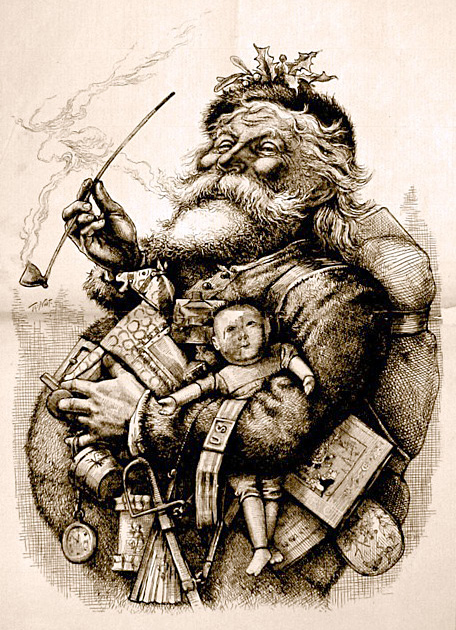
The real Santa Claus

Last week at the dinner table, our 3-year old son Dylan declared, "Santa Claus is BAD!! Santa Claus is BAD!!"

We weren't sure how he arrived at this conclusion, since we'd never referred to Santa Claus as "bad" before, so we probed a little deeper. Maybe, we thought, someone at church had told him this? As time went on, we remembered that Dylan had just watched "How the Grinch Stole Christmas" a couple days earlier, and apparently, he still thought the Grinch was Santa Claus and that he was a bad guy!

As we thought more about it, we realized Dylan had never really heard or seen the classic story of Santa Claus as a jolly old elf who lives on the North Pole and delivers presents on Christmas Eve to boys and girls around the world. So, last week, we watched the 1960s animation "Rudolph the Red-Nosed Reindeer" as a family. (We've reminded Dylan several times that Santa is just a "fun story" while Jesus is real.)

Of course, neither the Grinch nor the elf in the red suit tell us the real story of Santa Claus...

Santa Claus's roots can be traced back to St. Nicholas of Bari. The son of wealthy parents, Nicholas was born in the fourth century in the town of Patara, Lycia (now part of Turkey). Legend records that when his parents died, the young man took all the family's money and distributed it to the needy in his hometown. He then accepted the call to full-time Christian service, becoming a monk when he was only seventeen, and shortly thereafter, a priest. ... Nicholas must have been a remarkable man, wise beyond his years and exhibiting a maturity that few gain until they are well past forty. (Ace Collins, Stories Behind the Great Traditions of Christmas, 159-60)
Gene Edward Veith wrote an article in World Magazine a few years ago that reveals even more about this interesting character:
[Nicholas] was also a delegate to the Council of Nicea in a.d. 325, which battled the heretics who denied the deity of Christ. He was thus one of the authors of the Nicene Creed, which affirms that Jesus Christ is both true God and true man. And unlike his later manifestation, Nicholas was particularly zealous in standing up for Christ.

During the Council of Nicea, jolly old St. Nicholas got so fed up with Arius, who taught that Jesus was just a man, that he walked up and slapped him! That unbishoplike behavior got him in trouble. The council almost stripped him of his office, but Nicholas said he was sorry, so he was forgiven.
Wow. I'm starting to like the real Santa Claus more and more.

Friday, December 19, 2008

The quest for coolness

As you've probably heard, Rick Warren has been asked to give the invocation at Obama's inauguration ceremony, and the gay and lesbian community are outraged. Al Mohler has written a very important article on this incident and its broader implications for pastors and Christians everywhere. Here's the gist:

[Warren] now finds himself in a whirlwind, and he will not be the last. Pastor after pastor and church after church will face a similar challenge in short order. No matter how cool you think you are or think that others think you are, the hour is coming when the issue of homosexuality -- taken alone -- will be the defining issue in coolness. If you accept the full normalization of homosexuality, you will be cool. If you do not, you are profoundly uncool, no matter how much good work you do nor how much love and compassion you seek to express.
Read the whole article here.

Thursday, December 11, 2008

The death of mainstream journalism

Journalistic integrity in the mainstream media continues to die a slow and agonizing death. Accuracy, thoroughness, and impartiality are totally absent from the discussion of today's most controversial issues. Honest reporting has been replaced by its evil twin: secularist propaganda.

Case in point: this week's issue of Newsweek magazine. The cover article is entitled "The Religious Case for Gay Marriage." The subtitle of the online article says "Opponents of gay marriage often cite Scripture. But what the Bible teaches about love argues for the other side."

This is obviously a highly volatile issue, with strong opinions on both sides. Over 70 million dollars were spent either for or against the Proposition 8 campaign in California alone. Yet Lisa Miller of Newsweek has completely misconstrued the evidence, failing to quote a single conservative proponent of the biblical definition of marriage between one man and one woman.

I would encourage you to read Al Mohler's critique of the article here. His conclusion:

Newsweek could have offered its readers a careful and balanced review of the crucial issues related to this question. It chose another path -- and published this cover story. The magazine's readers and this controversial issue deserved better.
Newsweek has a circulation of over 3 million readers, and this magazine will be appearing on newstands everywhere. The world is grappling with the idea and implications of same sex marriage. Are we prepared to give a gracious and biblical response?

Wednesday, November 12, 2008

Benefits of a recession

Tired of all the bad economic news? Michael Hyatt shares ten benefits of a recession:

  1. It causes you to get more creative.

  2. It forces you to make the tough decisions.

  3. It thins out the competition.

  4. It makes you realize you can’t take anything for granted.

  5. It reminds you that real wealth isn’t about the stuff you own.

  6. It fosters out-of-the-box thinking.

  7. It makes it easier to abandon business-as-usual.

  8. It brings you back to the basics.

  9. It accelerates change.

  10. It causes you to be less wasteful.
That's a positive way of looking at it! On the other hand, if the government keeps bailing every industry out, we are going to lose some of these corrective measures that the free market will naturally take.

Several of these benefits apply to the church as well. While I don't "enjoy" these tough economic times, it has caused our church to become better stewards of what we have, and to think creatively about how to do ministry in the most effective way possible. For example, we switched from color bulletins to black-and-white, and installed window unit air conditioners in our offices that saved us hundreds of dollars this summer. If our budget hadn't been tight, we may not have made these simple, cost effective changes.

Monday, November 10, 2008

In God we do not trust

Last Tuesday, Mark Driscoll offered some excellent thoughts on the Presidential election. Without realizing it, Americans are longing for a savior who will atone for their sins, and they are yearning for a king who will keep them safe from terror.

Here's an excerpt:

People are longing for Jesus, and tragically left voting for mere presidential candidates. For those whose candidate wins today there will be some months of groundless euphoric faith in that candidate and the atoning salvation that their kingdom will bring. But, in time, their supporters will see that no matter who wins the presidency, they are mere mortals prone to sin, folly, and self-interest just like all the other sons of Adam and daughters of Eve...

The conclusion for pastors:

...I would encourage all preachers to preach the gospel of Jesus Christ and repentance of personal sin. He alone can truly atone for our sins. He alone can deliver us from a real hell. He alone is our sinless and great King. And, he alone has a Shalom kingdom to offer.

You can read the whole article here.

HT: Luke MacDonald

Tuesday, November 4, 2008

Providence and the presidency

The results are in: our nation has elected Barack Obama to be the next President of the United States. It certainly will be interesting to see where President Obama takes us in the years ahead. Will America become a socialist nation? Will abortion rights expand? Will the Supreme Court grow increasingly antagonistic toward religious liberties? Will Obama's leadership be "tested" early in his term by a major terrorist attack? Only the Lord knows what will happen, and it profits us nothing to worry (Matt. 6:34).

Thankfully, all things - including democratic elections - are guided by the provident hand of God. Wayne Grudem defines providence this way: "God is continually involved with all created things in such a way that he (1) keeps them existing and maintaining the properties with which he created them; (2) cooperates with created things in every action, directing their distinctive properties to cause them to act as they do; and (3) directs them to fulfill his purposes." (Systematic Theology, p. 315)

Three times in the past four days, God has reminded me of His providence:

  • As Abraham led his beloved Isaac up Mount Moriah to be a sacrifice, he reassured him, "God will provide for Himself the lamb for the burnt offering, my son" (Gen. 22:8). I was encouraged by this on Saturday in a message by R. C. Sproul.

  • As Joseph recalled the betrayal of his brothers and the years spent as a slave and prisoner in Egypt, he told his brothers "Now, therefore, it was not you who sent me here, but God...you meant evil against me, but God meant it for good" (Gen. 46:8; 50:20). I was reminded of this yesterday in a sermon by Dr. Will Varner.

  • And just earlier today, I read this quote from Spuregon posted by the Sola Panel: "I believe that every particle of dust that dances in the sunbeam does not move an atom more or less than God wishes—that every particle of spray that dashes against the steamboat has its orbit as well as the sun in the heavens—that the chaff from the hand of the winnower is steered as the stars in their courses. The creeping of an aphid over the rosebud is as much fixed as the march of the devastating pestilence—the fall of sear leaves from a poplar is as fully ordained as the tumbling of an avalanche."
God is provident in all things. Even these timely reminders were due to the provident hand of God. And tonight, in the wake of this historic election, I take fresh comfort in God's providence. He is still in control of His universe, He is still building His church, and He is still directing all things to fulfill His good and wise purposes.

Monday, October 20, 2008

The sixties revolution

I recently finished reading The Things that Matter Most by Cal Thomas. I'm a sucker for library book sales, and I found this book at a local sale about a month ago.

Thomas wrote this book shortly after Bill Clinton came to office. What I found so interesting was how the author described Clinton as a child of his times, the epitome of the 60s revolution. This would prove even more true than Thomas realized, as Clinton would later be impeached for perjury and obstruction of justice after his sexual promiscuity and disgracing of the Oval Office.

At any rate, I think Thomas does an excellent job of capturing what really went on in the 1960s. When I read David Well's The Courage to Be Protestant, he said that the private spirituality and rejection of all authority that we see today are deeply rooted in the 1960s. But having not lived during the 60s, I always felt like Wells assumed I knew what he was talking about. Thomas, on the other hand, walks you through that infamous decade and lists some of the distinguishing marks of those times.

Thomas says on p. 3, "To understand why the promises [Baby Boomers] are making to us today won't work, it is crucial that we examine the promises they made before, which they broke." These failed promises then set the agenda for the rest of Thomas' book, as he gives one example after another of how these promises were flawed and have done nothing but wreak havoc in society. Here's the list:

  • The Promise of Liberation from the Traditional Family
  • The Promise of Unrestrained Expression
  • The Promise of Pharmaceutical Enlightenment
  • The Promise of Sexual Freedom
  • The Promise of God's Death
  • The Promise to End Poverty
  • The Promise of Preferential Treatment for the Young and Strong
  • The Promise of Progressive Education
  • The Promise that Bigger Government will do it all for You
Sound familiar? These promises of the sixties revolution are still alive and well today, and are still producing the same empty results. They are tied to a worldview that is essentially humanistic and hedonistic, denying the existence of a just, jealous, merciful, and sovereign God who has revealed His nature and His will in the Bible.

Just as Adam and Eve discovered, when we pursue the promises of happiness apart from God, we are eventually in for a rude awakening.

Friday, October 10, 2008

Depending on God in this economic crisis

The economic tailspin continues. FoxNews reports this morning, "Amidst the greatest financial crisis in the U.S. since the Great Depression, the Dow is on pace to suffer its worst weekly plunge in its 112-year history even as reports of another government-led financial rescue swirl. "

Families, banks, and even the federal government are taking desperate measures to stave off a full-blown recession or depression. But in the midst of this crisis, we must not forget to turn to the Lord for help. Depending on God is the safest and most fundamental step we can take in this turbulent time.

Centuries ago, when the Israelities felt the threat of war from their enemies, they took drastic military measures to protect themselves:

In that day you depended on the weapons of the house of the forest, And you saw that the breaches in the wall of the city of David were many; And you collected the waters of the lower pool. Then you counted the houses of Jerusalem and tore down houses to fortify the wall. And you made a reservoir between the two walls for the waters of the old pool. (Isaiah 22:8-11)

All these things made good sense. But Israel neglected the one thing that was most important: to trust in God. Verse 11 continues,

But you did not depend on Him who made it, nor did you take into consideration Him who planned it long ago.

From a military standpoint, weapons, fortifications, and a reliable water supply were all good measures to take. But apart from God, these things were impotent to save Israel.

Likewise, government bailouts, interest rate adjustments, CEO changes, and other emergency actions might prevent financial calamity, but apart from God, these things will not ultimately rescue us.

In this season of turmoil, God is calling us to stop trusting in human institutions and worldly riches, and to submit to Jesus as Savior and Lord of our lives. Let us start depending on the One who made us, who gave us our money, and who instilled within us the principles for a free market economy. He alone is unchanging and ultimately in control over all things. And He calls for our absolute trust, not only for financial provision, but for eternal salvation.

Tuesday, September 30, 2008

The economic pogo stick

So, today the Dow is up 300 points again, after suffering its worst single-day loss yesterday. What's going on??

I've been following the current economic crisis only from a distance - scanning headlines, reading an article here or there, and just trying to wrap my mind around this enormous and complicated subject. Like so many other Americans, I feel a personal sense of ownership and concern over the developments on Wall Street and Capitol Hill.

More than anything else, this is an important time for us to trust in our sovereign Lord. It's easy to trust in God and be content when the economy is healthy, home prices are rising, and our portfolios are expanding. But when stocks plummet, savings vanish, home values dry up, and the whole economy is in jeopardy, God finally has a way of getting our attention. Have we really been trusting in Him, or in our own financial security?

Jesus did, after all, tell us to pray, "Give us this day our daily bread" (Mt. 6:11). He did command us not to worry about food and drink and clothing, for "your heavenly Father knows that you need all these things" (Mt. 6:32).

What then, is our responsibility in this economic crisis? "Seek first His kingdom and His righteousness, and all these things will be added to you" (Mt. 6:33). Here are a few practical ways we should be "seeking first God's kingdom" in our present situation:

  • Ask God to grant wisdom to our political and economic leaders (1 Tim. 2:1-2)
  • Cast your own financial anxieties upon God, for He cares for you (1 Pet. 5:6)
  • Don't speculate about what might happen, and whether our nation is on the brink of an economic meltdown. Worry profits nothing (Mt. 6:27).
  • Don't resort to grumbling and complaining over political ineptitude (Phil. 2:14)
  • Even during affliction, continue to give to the Lord and His church as an expression of your trust in God and love for people (2 Cor. 8:2)
  • Stay informed and make wise financial decisions. Do not panic and act hastily. (Prov. 21:5)
  • Thank God that, if you know Jesus Christ, your eternity is completely secure with Him; you have "an inheritance which is imperishable and undefiled and will not fade away, reserved in heaven for you" (1 Pet. 1:4).
  • Pray for those who have foolishly put their trust in riches (Prov. 11:28), that God will use this trial to draw many to Himself. Be sensitive to those around you that might be very burdened or frightened right now, and seek to minister the gospel to them.
We're witnessing a modern-day example of Proverbs 13:11: "Wealth gained hastily will dwindle, but whoever gathers little by little will increase it" (ESV). Only the Lord knows what will be the outcome of this economic crisis. Our duty is to trust Him and seek first His kingdom as we watch this drama unfold.

Friday, August 29, 2008

Home alone

While my wife and kids are in Colorado visiting my parents, I'm at home. All alone. Things have been awfully quiet around here the past few days. Without my lovely wife, my rambunctious two-year old son, and my energetic 6 month-old daughter (who is usually either laughing or wailing), the house is strangely silent. Tonight, all I hear are the ticking of the clock, the chirping of the crickets, and the distant rattling of our swamp cooler.

With the family gone, I've been able to spend some extra time in the Word and in prayer, to tackle some projects in the garage, and do quite a bit of extra reading. Right now, I'm reading up on strategic planning and church growth as I prepare for a Prayer and Planning Retreat with our church leaders next month.

I've also watched a little more TV this week than usual: a Monk episode, an old MacGyver episode, a Danger Man episode, and the Pirates of the Caribbean movie. Those were nice times to wind down and relax. Peace and quiet around the house has been nice for a time, but I'm definitely looking forward to having the family back home next Thursday.

Natalie asked me on the phone tonight what I thought of McCain's pick of Sarah Palin as VP. I told her I'm thrilled by the issues Palin stands for, but must admit I'm cautious about having a wife and mother serve in such a demanding position while she still has several kids at home. Her youngest, Trig, is only four-months old and has Downs Syndrome (Click here to read Al Mohler's account of this touching story). I guess I have to trust that Sarah and her husband Todd will not let the campaign and the possibility of being vice president get in the way of her even more honorable and God-given duty to her family.

At any rate, I'm sure Palin's spot on the ticket will help keep the public spotlight on abortion and the pro-life movement. The sanctity of life will no doubt continue to receive a good bit of attention in the upcoming convention and debates. And that, I believe, will be a very good thing. Issues like oil drilling, health care, immigration, and even the war on terror, as important as they all are, still pale in comparison to the tragedy of 40 million unborn children being slaughtered in our country since Roe v. Wade.

Friday, July 4, 2008

Christ

Happy Independence Day!

This week we come to chapter six in The Courage to Be Protestant. I thought this chapter was outstanding. This is David Wells at his best, brimming with fresh cultural insights and exalting the glorious gospel of Jesus Christ. This chapter alone is worth the cost of the book.

Early in the chapter, Wells shares some very interesting statistics. In America, "78 percent of people say they are spiritual. [But] When solving life's dilemmas, 56 percent say they are more likely to rely on themselves than on an outside power like the God of the Bible. And 40 percent claim specifically to be spiritual but not religious...There clearly has been a surge in spiritual appetite that is either hostile to religion or, at least, has lost confidence in institutionalized religion" (p. 179).

Haven't you noticed this? People seem increasingly fascinated by spiritual things. Prayer and meditation are now respectable activities. Faith is a central topic in this presidential election. More and more spiritual books are hitting the New York Times bestseller list. Even Jesus has become "cool" in the eyes of pop culture. Yet at the same time, many churches and denominations are languishing.

What's going on here? Why is there a turning away from the church and organized religion? And what's the difference between calling yourself "spiritual" versus "religious"? Wells explains there are two basic families of "spirituality" in life - two options in how our spiritual beliefs are shaped.

The first kind of spirituality is "from below." It involves the sinner reaching upward (or inward) for spiritual meaning. It starts in human consciousness and tries to reach above to make connections into the divine. It is self-initiated and self-sufficient. And it is pagan. Today, this spirituality "from below" involves "a private search for meaning, a search for connection to something larger than the self. It is in fact a self-constructed spirituality" (p. 179).

It's 'truth' is private, not public. It is individualistic, not absolute. It is about what I perceive, about what works for me, not about what anyone else should believe. And this 'truth' is verified psychologically and therapeutically. The test of its truthfulness is simply pragmatic. Those who are on this spiritual journey - and that is the most popular metaphor - have no destination in mind...There are no doctrines to be believed, no rules to be obeyed, and no practices to be followed. There is no worldview to which seekers must commit themselves. Nothing is fixed in eternity or by eternity, but all is in motion, everything is provisional, all is subject to ongoing experimental confirmation, all is adaptable to our internal needs (pp. 183-84).
The alternative (and correct) kind of spirituality is "from above." It is initiated from above and moves downward. It sees God reaching down in grace to communicate with and save sinners. For we must recognize that "God hides himself from us, that he cannot be had on our terms, and that he cannot be accessed from 'below' through natural revelation" (p. 190). The fullest expression of this spirituality "from above" is found in Jesus Christ, who emptied himself of divine glory, took the form of a man, came down to earth, obeyed God's law, inaugurated a new kingdom, died for our sins, was raised up, and has returned to heaven.

Wells concludes,
"The only future there actually is, is the one established by God in Christ, the one wrought in time at the cross that alone reached into eternity. But we must receive entry into this future. This is not our self-constructed future. It is God's. It comes from above, not from below...Only in this new order can be found meaning, hope, and acceptance with God. It was truth, not private spirituality, that apostolic Christianity was about. It was Christ, not the self, who offered access into the sacred. it was Christ, with all his painful demands of obedience, not comfortable country clubs, that early Christianity was about...Images we may want, entertainment we may desire, but it is the proclamation of Christ crucified and risen that is the church's truth to tell" (p. 207).
We are approaching the end of this book; there's only one more chapter to go. The final chapter is on the church, and I expect Wells will take us full-circle to show how marketers, emergents, and classic evangelicals must show the courage to speak and live the Protestant truth in this postmodern age.

Please leave a comment on chapter six below. No, really, PLEASE leave a comment. This is supposed to be a book club, but I'm hardly getting any comments out there! :) I really do enjoy your input.

Thursday, June 26, 2008

Self

It sounds like Pixar has done it again. Their new animation WALL-E is scheduled to open in theaters tomorrow, and World Magazine writes a very favorable review. From what I understand, the story follows WALL-E, a little trash compactor robot, who discovers a wonder for creation, a love interest in a girl robot name EVE, and a disappointment in human beings. "Because they live to be cared for rather than to care, the few human beings WALL-E meets have become, to use [director Andrew] Stanton's words, giant babies—literally feeding on milk rather than solid food."

This picture of a selfish, bloated humanity is not so different from David Well's description in chapter five of The Courage to Be Protestant.
This chapter is simply entitled "Self." Wells may be a deep thinker, but he sure does seem to like short chapter titles.

First, here is a quick review of the book so far:

  • Chapter one - Over the past 75 years, evangelicalism has divided into three distinct constituencies: classical evangelicals, marketers, and emergents.
  • Chapter two - As churches continue to downplay theology and Bible knowledge, more and more members are developing a consumer-mentality.
  • Chapter three - In contrast to postmodern society which has denied any absolute standard of truth and morality, Christianity is all about truth - both understood and applied.
  • Chapter four - The triune God of the Bible has attributes which make Him both "near" and "distant" from His creation. It is only through God that the universe has meaning and that people have hope; the self cannot bear the weight of being the center of reality.
In chapter five, Wells continues to explore the idea of the "autonomous self" that has replaced God as the center of the universe. He explains that the rugged individualism that always characterized America began to turn inward in the 1960s. By that time, "The self had become the source of all values. The pursuit of the self was what life was all about...Now it is about finding the self for yourself, discovering your inner potential for your own benefit, esteeming your self, and developing new ethical rules that serve the discovery of...the self" (p. 136).

Two illustrations of our self-centeredness are that we have become a very sensitive and litigious nation. Regarding our sensitivity, Wells observes, "From all of this has arisen a busy and very profitable industry of healers, consultants, grief counselors, writers, and various other purveyors of comfort to the fragile and afflicted. In America, we have one-third of the world's psychiatrists, two psychotherapists for every dentist, and more counselors than librarians" (p. 140). In regard to our litigiousness, Wells notes, "As the sense of responsibility for personal behavior has shrunk, the need for litigation has increased. America has more lawyers than the rest of the world combined" (p. 159). Once again, these statistics confirm the "American paradox" that the author mentioned earlier in the book. "We have unparalleled abundance but, at the same time, are being hollowed out" (p. 67).

There are four areas in which Western civilization has fundamentally changed in our thinking about "self." First, we now talk about values (what is right for each person) instead of virtues (matters of moral character). Second, we now emphasize personality (appearing good) above character (being good). Third, we now focus on self (how we are each distinct, unique, and special) instead of nature (what is common to all humanity). Fourth, we now experience shame (awkwardness about being discovered) instead of guilt (culpability before God) over our sin.

What's the solution to all of this? Should Christians contextualize our message into postmodern, self-help dress? No. Churches must not reduce the gospel to a therapeutic, felt-needs oriented
message that simply offers a better life and a better you. The gospel will certainly produce that, but we cannot replace the benefits of the gospel with the gospel itself. The gospel says that man has a sin nature and is not essentially innocent (p. 166). The gospel says that sin completely separates us from God and that all of us are in need of reconciliation through Christ (p. 168). The gospel says that faith is not mere intellectual assent to the facts about Jesus, but a radical change in our thinking, values, and behavior.

Wells concludes his chapter with a statement bursting with hope: "The fact that the modern self is empty and disintegrating, that our (post)modern society is fragmented and fragile, presents biblical faith with a truly golden moment. A deep longing exists in our society to see the real thing, to see lives lived out that have authenticity, that have substance. This authenticity, however, has nothing to do with following the broken promises of the self movement, which is now simply bankrupt. It has everything to do with taking our place before a holy God, through Christ, in such a way that his character, as it were, reaches into our lives with both the restraint and direction we need if we are to be restored" (pp. 173-74). May all of us be faithful in boldly speaking and authentically living out the truth of the gospel to a watching world.

For next week, we will read chapter six together on the subject of "Christ." Please take a moment to leave a comment below and share your reactions to this chapter.

Thursday, June 12, 2008

SBC resolution on same-sex marriage

This week at the annual convention in Indianapolis, Southern Baptists passed a resolution in response to last month's Supreme Court decision in Sacramento. I think it is a well-crafted document. It's an urgent call to action for all Christians to stand up for the biblical definition of marriage. Here's the resolution:

WHEREAS, On May 15, 2008, the California Supreme Court struck down the state’s ban on same-sex marriage thus frustrating the will of the people who, on March 7, 2000, voted in favor (61.4%) of Proposition 22 which affirmed, “Only marriage between a man and a woman is valid or recognized in California”; and

WHEREAS, This decision has dire national implications because California law will allow same-sex couples from any state to marry in California, return to their home state, and challenge that state’s traditional marriage laws based on the full faith and credit clause of the Constitution of the United States; and

WHEREAS, The United States Congress has repeatedly refused to pass a constitutional amendment defining marriage as exclusively between a man and a woman, thus providing no federal protection from attacks against traditional marriage; and

WHEREAS, Marriage is ordained by God as a permanent union of one man and one woman (Genesis 1:27-28; 2:24); and

WHEREAS, Jesus reaffirmed marriage as a sacred, monogamous, and life-long institution joining one man and one woman (Matthew 19:4-6); and

WHEREAS, Any action giving homosexual unions the legal status of marriage denies the fundamental immorality of homosexual behavior (Leviticus 18:22; Romans 1:26-27; 1 Corinthians 6:9-11); and

WHEREAS, The people of California have collected over 1.1 million signatures on a petition requiring the state to place a referendum on the ballot in November defining marriage as exclusively between a man and a woman; now, therefore, be it

RESOLVED, That the messengers to the Southern Baptist Convention meeting in Indianapolis, Indiana, June 10-11, 2008, wholeheartedly support the people in California who have worked tirelessly to place this referendum on the ballot; and be it further

RESOLVED, That we strongly urge all Southern Baptists in the state of California to be informed about this issue and to exercise their civic and moral duty by working diligently to support and voting to pass this referendum; and be it further

RESOLVED, That we encourage all Christian pastors in California and in every other state to speak strongly, prophetically, and redemptively concerning the sinful nature of homosexuality and the urgent need to protect biblical marriage in accordance with God’s Word; and be it further

RESOLVED, That we call on all Southern Baptists and believers from all denominations everywhere to pray for the people of California as they seek to right this terrible wrong that has been forced upon them by the California Supreme Court’s overturning of the vote of the people and to pray for the people of every state where biblical marriage is under attack; and be it further

RESOLVED, That we reaffirm our historic and consistent support of the biblical definition of marriage as an exclusive union between a man and a woman; and be it finally

RESOLVED, That we once again call on the United States Congress to pass, the President to sign, and the states to ratify a constitutional amendment defining marriage as exclusively between a man and a woman.
Any suggestions on how we should live this out practically? I plan to share this in our business meeting on Sunday night and begin a dialogue. Certainly, pastors should be willing to preach on the issue, while not growing preoccupied with politics in our sermons. Christians across the land are also encouraged to join the ProtectMarriage.com coalition to receive their email updates or donate by clicking here. I have added my name today as an endorser.

Let's remember that while we should be passionate about the truth, we must also conduct ourselves in a spirit of love and compassion. Homosexuals are watching us now more than ever. Will they perceive Christians as angry gay-bashers, or as people who cherish God's law and are concerned about those souls who have been drawn into the homosexual lifestyle?
We must love the sinner, but hate the sin. Homosexuality is no worse than any other sin. All sin is a breach of God's law and equally heinous in His eyes (James 2:10), needing freedom and forgiveness through Christ (Romans 6:23; Acts 13:38-39). What sets this sin apart is the devastating consequences it will have upon every man, woman, boy, and girl in our society if it is normalized and legalized.

Tuesday, June 3, 2008

Marriage amendment heads to the ballot

From the ProtectMarriage.com coalition:

Secretary of State Debra Bowen yesterday certified the eighth initiative for the November 4, 2008, General Election ballot. The measure would amend California’s Constitution to define marriage as a union “between a man and a woman.”

The response from the people of this state has been unprecedented in support of marriage’s legacy, by responding with an all-out volunteer signature campaign,” said Ron Prentice, CEO of the California Family Council and Chairman of the ProtectMarriage.com coalition sponsoring the amendment. “We’re so grateful to the over 1.1 million voters who signed the marriage petition in time for the November election. Passing this amendment is the only way for the people to override the four supreme court judges who want to re-define marriage for our entire society.”

Please continue to give your prayer and financial support to this effort. For more information, please visit www.ProtectMarriage.com.