Showing posts with label books. Show all posts

Thursday, August 27, 2009

Book review – The Back of the Napkin

Have you ever wrestled with a subject that was hard to understand or explain? Maybe it was a concept in school, a project at work, or even a matter of theology. Visual thinking may have been just the tool you needed.

Dan Roam introduces us to visual thinking in his excellent little book The Back of the Napkin: Solving Problems and Selling Ideas with Pictures. Say goodbye to clumsy PowerPoint slides, complicated spreadsheets, and endless bullet point lists. It’s time to return to the good old-fashioned pencil and paper or whiteboard.

In The Back of the Napkin, Roam opens with a series of intriguing questions…

What if there was a way to more quickly look at problems, more intuitively understand them, more confidently address them, and more rapidly convey to others what we’ve discovered? What if there was a way to make business problem solving more efficient, more effective, and – as much as I hate to say it – perhaps even a bit more fun? There is. It’s called visual thinking, and it’s what this book is all about: solving problems with pictures (p. 3).

The author spends the first half of his book introducing several important principles:

  • 3 Basic Visual Thinking Tools: your eyes, your mind’s eye, and hand-eye coordination.
  • 4 Steps in the Visual Thinking Process: look, see, imagine, and show.
  • 5 Questions that help open our mind’s eye: the SQVID method.
  • 6 Ways we see and show ideas: who/what, how much, where, when, how, and why.

Then, in the second half of his book, Roam gets practical. He applies all these principles to an extended case study of a fictitious software development company called SAX Inc. The book bogs down a little at this point, but it’s important for him to carry out the whole process from beginning to end.

For me, the most helpful part of the book was the SQVID (pronounced “squid”) method. It’s an acronym Roam created to show ten different ways of thinking about a subject: Simple vs. Elaborate; Qualitative vs. Quantitative; Vision vs. Execution; Individual vs. Comparison; and Change vs. As Is (The Greek letter Delta is the symbol for Change). Amazingly, by thinking of an idea in these ten different ways, your imagination is stretched and your mind’s eye is trained to look in whole new directions. Both the left and right hemisphere of your brain are exercised.

Let me give you a practical example. As I prepared last Sunday’s sermon on John 19, I decided to use the SQVID method to think about and sketch out different ways Christ shows His care to His disciples. This is what I came up with:

napkin

It may look like a bunch of gibberish at first, but it was actually quite helpful. Just taking time to think through these ten different aspects of Christ’s care caused me to look in a number of new directions, and then gradually narrow down how I wanted to illustrate and apply the passage I was preaching.

Visual thinking is a vital principle for both learning and teaching, and I can’t think of any better place to start learning about the subject than The Back of the Napkin.

Tuesday, August 18, 2009

Free copy of Finally Alive

Logos is giving away John Piper's book Finally Alive in Libronix format for FREE.

As we were thinking of ways to promote the John Piper issue, we discussed giving away a free download of Finally Alive for Logos Bible Software to everyone who subscribed this month. The more we thought about the book and John Piper’s commitment to make as many of his resources available for free as possible, we decided to give it away to everyone, not just to those who subscribe. This book is a brand new addition to the Logos format, and you get to be one of the first to receive it! Be sure to download it now, because this offer will expire September 14, 2009.

While we hope that you enjoy this free book and the above copy of John Piper’s cover story, we also hope that you will subscribe to Bible Study Magazine and receive an entire year’s worth of great Bible study articles and resources.

Click here to download the book in Libronix format.

In case you're not aware, all of Piper's books can be downloaded in .pdf format for free from Desiring God.

Thursday, August 13, 2009

Norman Geisler library at a ridiculous price

Now through August 19, you can buy the entire Norman Geisler Library on Libronix for only $22.95 (90% off the list price, $7 off the normal Rejoice Software price).

This set includes the following volumes:

  • Answering Islam
  • Baker Encyclopedia of Christian Apologetics
  • Christian Apologetics
  • Come, Let Us Reason: An Introduction to Logical Thinking
  • Introduction to Philosophy: A Christian Perspective
  • Miracles and the Modern Mind: A Defense of Biblical Miracles
  • Roman Catholics and Evangelicals: Agreements and Differences
  • When Critics Ask: A Handbook of Bible Difficulties
  • When Cultists Ask: A Handbook on Cultic Misinterpretations
  • When Skeptics Ask: A Handbook of Christian Evidences
  • Why I Am a Christian: Leading Thinkers Explain Why They Believe
  • Worlds Apart: A Handbook on World Views
Just the Encyclopedia of Apologetics alone sells for $34 at Amazon.

Click here if you would like to add to your cart with the discount.

Friday, July 24, 2009

Book review: The Unforgiving Minute

The Unforgiving Minute is the spellbinding account of a soldier's rigorous training and grueling combat in Afghanistan. It's a dramatic coming-of-age story written by Captain Craig Mullaney, who is a unique mix of one part Army Ranger and one part Oxford Rhodes scholar. (I felt a particular kinship with him because we're the same age. He started at West Point in 1996, only one month before I started at The Master's College. We were both training for battle, though of a different kind.)

Having never served in the military myself, Mullaney's vivid prose gave me a deeper appreciation for our men and women in uniform, and a greater understanding of the Bible's frequent references to war.

Endorsed by General Petraus and Wesley-Clark, this book is an instant classic you will find very hard to put down.

Here's an excerpt, with a great illustration of endurance...

For a moment, sitting on the examining table, I considered quitting. Dozens had already quit. In Ranger parlance, they had LOM'd: dropped out for 'lack of motivation.' At West Point I had always risen to the challenges. The challenges of Ranger School, however, were on a different scale, and I wondered whether I could take two more months of punishment at this voltage. At the moment, motivation was scarce. A medical 'drop' was an honorable reason to leave Ranger School, I rationalized to myself. No one would call me a coward or a failure if I had a legitimate medical excuse. It was the easy way out. I would be on a plane home to Rhode Island in twelve hours, sitting by the pool with a margarita. Covered in mud and sweat, the prospect was especially appealing. Ranger School could wait a couple of years, I told myself. Maybe after Oxford?

Another voice, however, urged me to stay. This sort of decision had an audience of one. Forget what my father would say as he picked me up at the airport. Forget LoFaro, Ostlund, and Charlie. Would I be able to look at myself in the mirror again if I quit? So I stayed in the course, a decision I would curse during every painful march or sleepless night staring out at the dark from a cold patrol base. There were no good days in Ranger School, just variations of bad. It demanded an almost inhuman endurance.... (p. 96)

Tuesday, July 21, 2009

10 books every new Christian should own

Here's a list of ten books I believe every new Christian should own. They would make a great starter library to begin your walk with God and discover the riches of the Bible.

The first two are the best modern translations of the Bible, accompanied by helpful study notes, maps, charts, and other rich background material:

The next four books cover basic Christian beliefs and living:
The last four books are basic reference tools. They don't need to be read from cover-to-cover, but are important Bible study tools to keep close at hand on your shelf.

Monday, July 13, 2009

Books for the trip

No road trip would be complete without some good books to help the miles pass by. Here are some books our family enjoyed the last couple weeks during our travels and while relaxing in Colorado:

Fodor's Essential USA, 1st Edition: Spectacular Cities, Natural Wonders, and Great American Road Trips. Though this travel guide covers all 50 states, it was a great reference for the 6 states we traveled through. Some of our decisions on what attractions to visit came right out of this book. One feature I really liked was the suggested itinerary, depending on how many days you would be in an area: one day, two days, or even up to a whole week. While far from exhaustive, it's a great overview of our country's natural wonders and man-made attractions.

Frommer's Colorado. This book helped us navigate the Colorado Springs and Denver area during our stay with my parents, and during our two day retreat in Monument/Denver.

Russell Hitt, Sensei: The Life Story of Irene Webster-Smith. Natalie read this to me in the car on several of our travel days. A well-written story about a bold missionary to the young geisha girls of Japan in the early 20th century. We're about half way through the book.

C.J. Mahaney (ed.), Worldliness: Resisting the Seduction of a Fallen World. A wake-up call to deny ungodliness and wordly lusts in areas like media, music, clothing, materialism. I especially enjoyed Jeff Purswell's chapter on how we should love the world. Natalie noted this was a very appropriate book to be reading as we drove through Vegas.

Alva McClain, Greatness of the Kingdom. I've just begun reading this book in preparation for an upcoming series I will be preaching on the kingdom of God. McClain is clear and balanced. It's an excellent biblical theology on the complex subject of the kingdom of God.

Douglas Wilson, Future Men. This was a though-provoking guide on training up boys and young men in biblical masculinity. Drawing heavily from the Proverbs, his observations of our culture, and his own experience as a father, Wilson gives much fresh and practical teaching on the subject.

Ron Fontes and Justine Korman, Davy Crockett Meets Death Hug. Speaking of raising future men, here's a great book we're reading with our son Dylan about Davy Crockett and his friend Georgie hunting a ferocious bear.

Arnold Lobel, Frog and Toad Together. A collection of well-illustrated short stories about Toad and his adventures with Mr. Frog.

Elizabeth Prentiss, Stepping Heavenward. Natalie started reading this on the trip, so I asked her to write a description [she apologizes for making it so long, but she highly recommends the book!]. Written by the author of the beloved hymn, More Love to Thee, O Christ, this fictional "diary" is the account of young Katherine's journey toward Christlikeness. Through it all, we are pointed to love Christ more as we follow our new friend on her journey heavenward. It takes us though Katy's teenage years during which she struggles to understand if she truly loves Christ as her Savior. We watch as she strives to overcome her daily sinfulness, finally realizing that just as Christ saved her, only He can grant Katy holiness. We listen in as she shares her frustrations with a path God has given her and the mentors who point her to the good God may have even during times of great trials. For example, Mrs. Campbell (who has outlived her husband and children, and now endures great physical suffering) tells Katy the following on page 212:

"I was bound to my God and Savior before I knew a sorrow, it is true. But it was by a chain of many links; and every link that dropped away brought me to Him till at last, having nothing left, I was shut up to Him and learned fully what I had only learned partially, how soul-satisfying He is."

"You think then,"I said while my heart died within me, "that husband and children are obstacles in our way and hinder our getting near to Christ?"

"Oh, no!" she cried. "God never gives us hindrances. On the contrary, He means, in making us wives and mothers, to put us into the very conditions of holy living. But if we abuse His gifts by letting them take His place in our hearts, it is an act of love on His part to take them away or to destroy our pleasure in them. It is delightful," she added after a pause, "to know that there are some generous souls on earth who love their dear ones with all their hearts yet give those hearts unreservedly to Christ. Mine was not one of them."

Thursday, April 9, 2009

Book review: Living the Cross-Centered Life

How often do you think about and really dwell upon the cross? Once a week? Perhaps monthly at the communion table? Or once a year, on Good Friday?

C. J. Mahaney, in his book Living the Cross Centered Life, shows us that the cross should remain at the very center of our lives:

In the mist of our various responsibilities and many possible areas of service in the kingdom of God, one overarching truth should motivate all our work and affect every part of who we are: Christ died for our sins...

This, Paul says, is the main thing. Nothing else - not even things that are biblical and honorable - are of equal or greater importance than this: God sent His Son to the cross to bear His wrath for sinners like you and me.

If there's anything in life we should be passionate about, it's the gospel...That's why our attention must continually be drawn back to what John Stott calls "the great and most glorious of all subjects - the cross of Christ." (pp. 14-15)
To use a building metaphor, the cross is not merely the foundation of our faith. It is also in the walls, the ceiling, the floor, and the furnishings. It is all-pervasive.

Do you consider the cross to be "the great and most glorious of all subjects"? Do your thoughts and affections confirm this? I must confess that too often, mine do not. Hours and days go by when the cross has become stale, unappreciated, or overshadowed by more exciting topics or more pressing concerns. And that is why Mahaney's book is so desperately needed.

After stressing the importance of the cross (Intro - ch. 2), Mahaney explains its meaning (chs. 3-5), revisits its most poignant scenes (chs. 6-8), and shows how it is incredibly practical for us today. He teaches that only the cross can give meaning and hope to our suffering (ch. 9), offer assurance and joy (ch. 10), freedom from the law (ch. 11), and a clean conscience (ch. 12). The book closes with some practical suggestions on how to cultivate a more cross-centered mindset (ch. 13) and a final plea to keep the gospel the main thing (ch. 14).

Those who have seen or heard C. J. Mahaney know this is not mere theoretical information. It is intensely practical, fiery truth that has been impressed upon his own heart. I believe the same could be said of Mahaney that was once said of the Apostle Paul: that he has "determined to know nothing among you except Jesus Christ, and Him crucified" (1 Cor. 2:2). And for that reason, I believe Mahaney is uniquely qualified to write this book.

Living the Cross-Centered Life has helped me see all of Scripture, and interpret all of life, through the lens of the gospel. On this day and every day, may we never leave the foot of the cross.

Tuesday, April 7, 2009

Logos March Madness tournament

Logos Bible Software just finished a creative promotion based on the NCAA March Madness theme. They started with 64 digital books or collections, and asked users to vote on which titles should receive the greatest discounts.

The tournament champion was The Complete Works of Francis Schaeffer. You can see the entire list of winners here, along with several good discounts. Schaeffer's works are on sale for a whopping 75% off, while the Final Four are 45% off, and the Elite Eight are 40% off.

Thursday, March 12, 2009

40 books to strengthen your walk

Looking for books to add to your personal or church library? Do you want to read, but aren't sure where to begin or what's good? Monergism offers a list of 40 books they consider "both devotionally and theologically rich and have deeply impacted our ministry such that we want to set these apart as recommendations to you as a good place to start building a Christ-honoring library of books for your home."

These are not light Christian reading, but rich classics. Here's the list:

Truth For All Time - John Calvin

The Everlasting Righteousness - Horatius Bonar

The Holy Spirit - John Owen **

Chosen For Life - Sam Storms

When Grace Comes Home - Terry Johnson **

Knowing God - J.I. Packer

Saved by Grace - Anthony Hoekema

Sovereignty of God - A W Pink

Crook in the Lot - Thomas Boston **

The Christian in Complete Armour - William Gurnall **

The Bruised Reed - Richard Sibbes

Bondage of the Will - Martin Luther

The Religious Affections - Jonathan Edwards

History of the Work of Redemption - Jonathan Edwards

Reformed Doctrine of Predestination - Loraine Boettner

Redemption Accomplished and Applied - John Murray

The Enemy Within - Kris Lungaard

Mortification of Sin - John Owen

The Bible and the Future - Anthony Hoekma

A Case for Amillennialism - Kim Riddlebarger

God of Promise: Introducing Covenant Theology - Michael Horton

A Body of Divinity (Paperback) - Thomas Watson **

The Reason for God: Belief in an Age of Skepticism - Tim Keller

Always Ready: Directions for Defending the Faith - Dr. Greg L. Bahnsen

Pilgrims Progress - John Bunyan

Gospel and the Kingdom - Graeme Goldsworthy

Biblical Theology - Geerhardus Vos

Systematic Theology - Wayne Grudem

New Systematic Theology - Robert Reymond

Justification and Regeneration by Charles Leiter **

How People Change - Timothy S. Lane & Paul David Tripp

Addiction: A Banquet in the Grave - Ed Welch

Shepherding a Childs Heart - Ted Tripp

Today's Gospel: Authentic or Synthetic - Walter Chantry

Tell the Truth - Will Metzger

Lectures to my Students - C.H. Spurgeon

The Cross and Christian Ministry - D.A. Carson

Institutes of the Christian Religion (2 Vol Set) by John Calvin **

The Gospel Mystery of Sanctification by Walter Marshall

Finally Alive by John Piper

I've only read about eight of these books so far. Several others I own, but have not read yet. Overall, the list does represent some excellent material, both past and present.

As always, read with discernment and search the Scriptures like a Berean (Ac. 17:11). Some of these titles will present a Reformed eschatology and ecclesiology, while I believe the Bible consistently teaches a more Baptistic ecclesiology and dispensational eschatology. But overall, I think this list would be very edifying and strengthening to your walk.

Wednesday, March 11, 2009

Book Review: The Faithful Preacher

Last year at Together For the Gospel, I received a copy of The Faithful Preacher by Thabiti Anyabwile (pronounced an-yahb-wee-lay). I must admit this book was not what I first expected. I thought it would be a biography in the line of Piper's "Swans Are Not Silent" series. Instead, I found a compilation of sermons by three African-American preachers, each with a brief biographical introduction.

While I would have enjoyed reading more about the personal lives of these three men, I still found The Faithful Preacher to be a convicting and edifying read. Each man had a unique theme to his ministry.

Lemuel Haynes lived at the time of the American Revolution. Once an indentured servant, Haynes became the first African-American to be ordained in 1785. He had the remarkable duty of pastoring an all-white church for 33 years. Haynes gave special emphasis to conducting our ministry with an eye on eternity. "The work of a gospel minister has a peculiar relation to the future. An approaching judgment is that to which every subject is pointing and that renders every sentiment to be inculcated vastly solemn and interesting. Ministers are accountable creatures in common with other men; and we have the unerring testimony of Scripture that 'God shall bring every work into judgment, with every secret thing, whether it be good, or whether it be evil' (Eccles. 12:14). If none of our conduct is too minute to be known, we may well conclude that important affairs relating to the work and office of gospel ministers will not pass unnoticed" (p. 29).

Daniel A. Payne, born in the South in the early 19th century, was raised by his great aunt due to the early death of his parents. Payne had a passion for educating blacks, but was forced to leave South Carolina after a tragic law was passed in 1835 that made it illegal to educate slaves. For over 40 years, Payne served as a bishop in the African Methodist Episcopal Church and eventually as president of Wilberforce University in Ohio. He sharply rebuked pastoral laziness and ignorance, setting a high standard for the man of God: "To sum up all our ideas in a single sentence, he must be holy, studious, instructive, and wise, ever keeping his heart in contact with the Spirit of God, ever drinking from the pure fountains of truth. He teaches himself, that he may be able to teach others also" (p. 101).

The third and final character of the book was Francis Grimke, born to a slave mother and eventually serving as a pastor in Washington, D.C. for 60 years. Living through the Civil War, Reconstruction, World War I, and the Depression, Grimke decried racial prejudice and exhorted pastors to remain faithful to the gospel of Jesus Christ. "If we are not going to preach the gospel and teach the Word of God faithfully, we have no business in the ministry. And the sooner we get out of it, the better" (p. 181).

By reprinting these men's sermons and giving brief biographical sketches, Anyabwile has introduced us to three unsung heroes of the ministry; three men who overcame racial barriers to boldly serve Christ's kingdom; three preachers who eloquently defended the faith once for all handed down to the saints (Jude 3). Truly, these were men of whom the world was not worthy (Heb. 11:38).

May we heed their words and imitate their example, that Christ's message may continue to spread in the 21st century.

Friday, February 13, 2009

Book Review: Team Challenges

Planning church youth group activities can be a real challenge. Especially if you want to keep games fun and fresh week after week.

There are a lot of helpful gaming books on the market and even some good websites, but I've been frustrated by weaknesses many of these resources seem to share: many activities do not work well for small groups; many games involve embarrassing or inappropriate physical contact between genders; many games lack creativity and seem to just repackage the same concept into a thousand different variations; and some games breed an overly-competitive spirit which stifles godly, edifying relationships.

A helpful book I recently came across is Team Challenges: 170+ Group Activities to Build Cooperation, Communication, and Creativity. The author pools her years of experience in 4-H and other youth programs into a helpful book of "easy-to-implement activities that will keep kids laughing, having fun, and learning the benefits of teamwork, all at the same time."
Could you create a bridge that spans 18 inches using only 3 sticky notes and 10 cotton balls? Could you think of 20 things that come in pairs? Could you suspend a beach ball at least 3 feet high in less than five minutes using only a sheet of mailing labels and 25 sheets of newspaper? Could you and your friends completely flip a table cloth using only your feet? Could you plan a skit in only one minute about a loud guest visiting a library? These are only a sampling of great ideas in the book.

Chapters include:

  1. Creativity, Cooperation, and Communication. What are they good for?
  2. Get it Together. Gather your group and prepare for some fun.
  3. Everything but the Kitchen Sink. Commonly used materials and their uncommon uses.
  4. Tiny Tasks. Warm up with these quick activities.
  5. Talk It Up. Discuss options, share ideas, and make connections.
  6. Construction for the Whole Crew. Building towers, bridges, roads, and more.
  7. Move it! Physical activities.
  8. Show Me the Funny. Improv hilarity at its best.
  9. Trouble with Tasks? Working through some difficult spots.
Team Challenges fills a critical gap in game-planning that many other books seem to miss. It emphasizes cooperation rather than competition. It focuses on problem-solving rather than sheer physical prowess. It fosters creativity rather than repackaging the same old relay races. I believe it would be a great addition for any teacher, youth pastor, game leader, or children's resource room.

Thursday, February 5, 2009

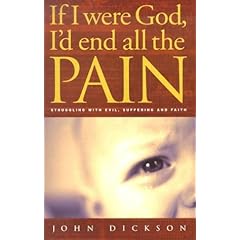
Book review: If I Were God, I'd End all the Pain

Why would a loving God allow so much suffering? All of us have wrestled with this question at some point. Almost every day as a pastor, I encounter people who are dealing with serious trials - people who may be asking this very question.

In the short book, If I Were God, I'd End All the Pain, John Dickson is not afraid to ask the question "Why?" In fact, he believes it's a healthy question that God Himself invites. The author shows that while there is still much mystery woven into our suffering, we can also be confident that Christianity provides the very best explanation for evil and suffering.

After showing why suffering does not disprove God philosophically (ch. 1), the author explains how four alternative faiths attempt to explain suffering.

  • Hinduism views suffering as karma, i.e. bringing balance for past wrongs.
  • Buddhism, which actually developed from Buddha's quest to explain suffering, believes all suffering is just an illusion. It stems from a desire or affection for things of the world (e.g. comfort, health, money, love, etc.). If we can simply strip away these desires and enter a state of nirvana (non-existence), then suffering will cease.
  • Islam believes all things are pre-determined by God, and that suffering is a direct result of Allah, the great "Unmoved Mover."
  • Atheism endures suffering as the natural, unhappy by-product of our random, godless universe.
In contrast to these four views, the Bible has a satisfactory explanation for suffering. Human violence and injustice, which causes so much of the suffering in this world, is really a perversion of the independence God originally gave the human spirit. People now live as "a law unto themselves, without reference to the Creator," and we are reaping what we sow. But what about the profound suffering caused by natural disasters, disease, death, starvation, etc.? These are a result of God's curse upon the world for our sin (Gen. 3:17-19). "The earth bears the scars, as it were, of the traumatic rift that has occurred between us and God; it contains an ever-present reminder that the Creator is displeased with our defiance of him."

The author does not merely explain suffering, but provides three comforting truths that give hope and peace even in times of suffering:
  • God will eventually judge and repay all the injustice in the world.
  • God will eventually restore and re-create His world in perfection.
  • By sending His Son to the cross, God Himself has suffered to the greatest degree, and through His suffering provides a substitute for us, so that we do not have to spend eternity apart from Him.
If I Were God, I'd End All the Pain is a brief but helpful Christian apologetic on suffering. While the Bible does not claim to give us all the answers, it gives us enough to keep clinging to God and persevering through life's darkest moments.

Monday, February 2, 2009

Sovereign Grace sale

In case you haven't heard yet, Sovereign Grace is holding a generous sale in February. Much of their music and book material is outstanding. Here's the announcement...

We’re doing it again. Having a ridiculous sale, that is.

Last year, during the month of February, we reduced the prices of our CDs and books. The response was overwhelming. So we decided to repeat the lunacy. Here’s the deal:

From February 1–28, at the Sovereign Grace store, you’ll find these prices:

* Sovereign Grace books (23 of them, including Worship Matters, Worldliness, and Living the Cross Centered Life): $7 each

* all CDs produced by Sovereign Grace Music (including Together for the Gospel Live, Psalms, Come Weary Saints, Awesome God, In a Little While, and Valley of Vision): $6 each

* all books in our Pursuit of Godliness series (Why Small Groups, This Great Salvation, and others): $4 each

But wait…there’s more!

During February, we’re offering our normal free shipping in the continental US (library rate). But on all international orders we’re offering a discount of 50% on USPS First Class International shipping.

Why are we doing this? Well, we figure that most of us have been affected by the present economic crisis. We want to do whatever we can to make it easier for people to benefit from what we produce. We want to serve churches and individuals by providing biblically informed, gospel-centered resources at a low cost. And we’d really like to give it all away, but for now, that’s not financially feasible…

So we offer the February sale. Enjoy.

And feel free to tell your friends.

Get the goods at: http://www.sovereigngracestore.com/

Saturday, December 20, 2008

Book Review: The American Patriot's Almanac

Don't let the word "almanac" scare you. This is a story book. But what makes this book so good is that the stories are true!

Bill Bennett and John Cribb make history come alive by retelling many of the best stories of America in a short and compelling way. Learn about the heroes, battles, geography, events, and inventions that make our country what it is today. This volume would be perfect for family time, or on the coffee table, or in the bathroom, or even for daily readings in a high school civics course.

The American Patriot's Almanac is broken down into 365 bite-sized portions that make it easy to read in a year. Each page includes one reading and an "American History Parade" of 4-6 notable events that took place on that date in American History. Sprinkled throughout the book are special features like "Fifty All-American Movies" and famous "Prayers for the American People." I was a political studies major in college, but I found myself learning something new on nearly every page. I was very glad to see the detailed index in the back, which makes this book stronger and even more useful.

Check this book out. You're sure to discover something new and to gain a deeper appreciation for the United States of America.

Monday, December 15, 2008

Christmas book giveaway


Trevin Wax over at the Kingdom People blog is doing a Christmas Book Giveaway worth over $250. Click here to find out how to enter your name in the drawing.

Thanks, Trevin, for this generous offer.

Tuesday, December 9, 2008

Religious Affections, Part I and II

Back in July, I said I would be reading through Religious Affections, by Jonathan Edwards. I don't know of any readers who planned to follow along with me, so I decided to take my sweet time on this project, reading just a little at a time as devotional reading.

So far, I've finished Parts I & II of Edwards' work and have really enjoyed it. Edwards stretches the mind and the soul, opening up new dimensions of understanding about God and human nature.

The main question he explores in the book is this:

What are the distinguishing qualifications of those that are in favor with God, and entitled to his eternal rewards? Or, which comes to the same thing, What is the nature of true religion? And wherein do lie the distinguishing notes of that virtue and holiness that is acceptable in the sight of God?
In other words, how can we know we are pleasing God? There are certain impulses that should characterize believers and help measure our growth in godliness. But before giving an answer, Edwards explains twelve "unreliable" signs of genuine religious affections in Part II:
  1. It is no sign one way or the other, that religious affections are very great, or raised very high.
  2. ...that they have great effects on the body.
  3. ...that they cause those who have them to be fluent, fervent, and abundant, in talking of the things of religion.
  4. ...that persons did not make them themselves, or excite them of their own contrivance and by their own strength.
  5. ...that they come with texts of Scripture, remarkably brought to the mind.
  6. ...that there is an appearance of love in them.
  7. ...[that people experience] many kinds, accompanying one ...
  8. ...that comforts and joys seem to follow awakenings and convictions of conscience, in a certain order.
  9. ...that they dispose persons to spend much time in religion, and to be zealously engaged in the external duties of worship.
  10. ...that they much dispose persons with their mouths to praise and glorify God.
  11. ...that they make persons that have them exceeding confident that what they experience is divine, and that they are in a good estate.
  12. ...that the outward manifestations of them, and the relation persons give of them, are very affecting and pleasing to the truly godly, and such as greatly gain their charity, and win their hearts.
This is as far as I've gotten in the book, but I've already been challenged against using common "signs" to judge our faith and measure that we are growing in grace. There are many good things on this list, but any of these twelve can be counterfeited by the Enemy and are not sufficient evidence of a genuine walk with God.

I'm looking forward to reading Part III of his book, where Edwards finally addresses what are the distinguishing marks of true religion.

Monday, November 17, 2008

Book Review: Respectable Sins

Christians often identify "sin" with the "really bad" stuff like murder, adultery, and theft. Avoid those things, and you're doing fine. But in Respectable Sins: Confronting the Sins We Tolerate, Bridges shows that sin is far deeper and more pervasive than we would like to admit. Most sins, for believers, are far more subtle - what Bridges calls "acceptable" or "respectable" sins. Yet these sins are also evil and offensive to God.

Why devote a whole book to the subject of sin? "The motivation for this book stems from a growing conviction that those of us whom I call conservative evangelicals may have become so preoccupied with some of the major sins of society around us that we have lost sight of the need to deal with our own more 'refined' or subtle sins" (p. 9).

In Respectable Sins, Bridges first deals with general principles of sin, forgiveness, and obedience. Then, beginning in Chapter 7, he looks as common sins that believers tolerate like anxiety, unthankfulness, pride, selfishness, impatience, judgmentalism, and sins of the tongue. The author concludes with a chapter on worldliness and then some practical help on where to go from here.

Having already written several Christian classics like the Pursuit of Holiness and Trusting God, Bridges has done it again with Respectable Sins. I found this to be a very fresh and convicting book. Every chapter gives a brutally honest exposure of my own sin. Bridges deals with issues in a practical way, sometimes giving personal examples of struggles in his own life. Most chapters were short and easy to read. The only drawback is that the Study Guide does not follow the same chapter order as the book. But whether you buy the study guide or use this as a stand-alone book, Respectable Sins is highly recommended.

Saturday, July 19, 2008

Religious Affections

Jonathan Edwards is one of the greatest theologians of all time. He's the inspiration behind John Piper's "Christian hedonism," and is at the very heart of the "Young, Restless, and Reformed" movement. Yet I must confess, I've never read a complete book by Jonathan Edwards. Sure, I've read a couple of his articles here and there, and have read his famous sermon, "Sinners in the Hands of an Angry God," but I've really read very little by this great preacher and theologian. Lord willing, that is about to change.

For some time now, Tim Challies has been hosting a book club called Reading Classics Together, and they just started their next book. It's A Treatise Concerning Religious Affections, by Jonathan Edwards. And now that we have concluded The Courage to Be Protestant on this blog, I think I'll take a stab at Religious Affections. (In fact, maybe David Wells was good mental preparation for tackling Jonathan Edwards. Both of them are crazy smart!) Any of you are welcome to read along as well. If you do not own a copy of Religious Affections, you can read the text online for free at CCEL. I will personally be reading out of the two-volume Banner of Truth Works of Jonathan Edwards.

In the Preface, Edwards says the main purpose of his book is "to show the nature and signs of the gracious operations of God's Spirit, by which they are to be distinguished from all things whatsoever which are not of a saving nature" (p. 235).
I believe we should rejoice whenever someone confesses Jesus Christ as their Savior and Lord (cf. Lk. 15:10). But how can we discern genuine conversion from false religion? What are the marks of a true believer, and of the authentic work of the Holy Spirit? This is what Edwards will try to explain.

In fact, it was his critique of false religion that struck me the most
in this opening section: "It is by the mixture of counterfeit religion with true, not discerned and distinguished, that the devil has had his greatest advantage against the cause and kingdom of Christ. It is plainly by this means, principally, that he has prevailed against all revivals of religions, since the first founding of the christian church" (p. 235). Satan is a cunning foe, and he knows that twisting true religion is often a much more effective strategy than eliminating religion altogether.

May the Lord kindle our religious affections and help us "guard, through the Holy Spirit who dwells in us, the treasure [of the gospel] which has been entrusted to us" (2 Tim. 1:14).

Friday, July 11, 2008

Church

I was blown away by the opening sentence in Chapter 7 of The Courage to Be Protestant. David Wells begins, "What someone thinks about the church tells us exactly what that person is thinking about Christianity." Whoa. Is that true?

Wells is talking about the methods and programs and styles and philosophies of church ministry. But as I read that first statement, I was reminded of the many people who have become disillusioned with the church altogether. Many people have at some point been suffocated by a legalistic church, or felt betrayed by scandal in leadership, or been angered by the constant infighting. Many people have grown busy and tired and just decide to stay home on Sundays. Is it really true that their low view of the church is reflective of a low view of Christianity? Yes, to a large degree, I believe it is. And Wells explains why.

What happens in the churches "tells us how people are thinking about God, how they are relating themselves to the truth of his Word, how they see the world, how they think about human corruption - or if they think about it all all - how they think about the gospel, how they think about the poor and dispossessed, their own generation, affluence, and many other things besides" (p. 209). All of these, says Wells, are evident by how we think about and treat the church.

I think nearly everyone would agree that the church is in bad shape today. It seems like there is more scandal, more compromise, more corruption, and more division, while at the same time, there are fewer attending, fewer being baptized, fewer giving, and fewer serving. Our "public approval ratings" are dismal.
From a strictly human perspective, it seems the church is sinking faster than the Titanic. But what is the remedy to all of this? Wells says there are two ways to "rethink" the church. We can either rethink its nature, or rethink its performance.

Many people wrongly devote themselves to rethinking the performance aspect of church ministry. In a desire to help the church become more successful, marketers pour their energy into new business models, new technologies, new marketing techniques, and new polling data that will lend insight into doing church. Emergents, meanwhile, dabble more in the mystical, flirt more with the immoral, and celebrate more what is uncertain.

What we really need to be doing, Wells says, is rethinking the nature of the church. We need to reverse the "middling standard" of letting theology shrink to its lowest common denominator (p. 210). We need to distance ourselves from the worldly elements of the culture (p. 224). We need to restore the centrality of God's Word in our doctrine and preaching (p. 226), reinstate the proper administration of the sacraments (p. 233), and return to the biblical practice of church discipline (p. 237). These are the distinctives of the Protestant Reformation, and they are still worth defending today.

The wonderful reality of church growth is that humans are not responsible for it. God is. "The church is his creation and only he can grow it. He gives it its qualitative growth inwardly, in terms of character and obedience, and its quantitative growth outwardly in terms of numerical expansion" (p. 243). This is a truly liberating thought! It means that pastors and denominational leaders are not responsible for reinventing the church in order to make it more successful.

What God calls us to do is to think more biblically about the nature of the church, and to let that understanding shape our strategies and methods. The church should be humble. It should be loving. It should be emotional. It should be relevant. But all of this should be governed by a robust biblical theology about the true nature of the church. And this will take courage -- the courage to be Protestant.

Friday, July 4, 2008

Christ

Happy Independence Day!

This week we come to chapter six in The Courage to Be Protestant. I thought this chapter was outstanding. This is David Wells at his best, brimming with fresh cultural insights and exalting the glorious gospel of Jesus Christ. This chapter alone is worth the cost of the book.

Early in the chapter, Wells shares some very interesting statistics. In America, "78 percent of people say they are spiritual. [But] When solving life's dilemmas, 56 percent say they are more likely to rely on themselves than on an outside power like the God of the Bible. And 40 percent claim specifically to be spiritual but not religious...There clearly has been a surge in spiritual appetite that is either hostile to religion or, at least, has lost confidence in institutionalized religion" (p. 179).

Haven't you noticed this? People seem increasingly fascinated by spiritual things. Prayer and meditation are now respectable activities. Faith is a central topic in this presidential election. More and more spiritual books are hitting the New York Times bestseller list. Even Jesus has become "cool" in the eyes of pop culture. Yet at the same time, many churches and denominations are languishing.

What's going on here? Why is there a turning away from the church and organized religion? And what's the difference between calling yourself "spiritual" versus "religious"? Wells explains there are two basic families of "spirituality" in life - two options in how our spiritual beliefs are shaped.

The first kind of spirituality is "from below." It involves the sinner reaching upward (or inward) for spiritual meaning. It starts in human consciousness and tries to reach above to make connections into the divine. It is self-initiated and self-sufficient. And it is pagan. Today, this spirituality "from below" involves "a private search for meaning, a search for connection to something larger than the self. It is in fact a self-constructed spirituality" (p. 179).

It's 'truth' is private, not public. It is individualistic, not absolute. It is about what I perceive, about what works for me, not about what anyone else should believe. And this 'truth' is verified psychologically and therapeutically. The test of its truthfulness is simply pragmatic. Those who are on this spiritual journey - and that is the most popular metaphor - have no destination in mind...There are no doctrines to be believed, no rules to be obeyed, and no practices to be followed. There is no worldview to which seekers must commit themselves. Nothing is fixed in eternity or by eternity, but all is in motion, everything is provisional, all is subject to ongoing experimental confirmation, all is adaptable to our internal needs (pp. 183-84).
The alternative (and correct) kind of spirituality is "from above." It is initiated from above and moves downward. It sees God reaching down in grace to communicate with and save sinners. For we must recognize that "God hides himself from us, that he cannot be had on our terms, and that he cannot be accessed from 'below' through natural revelation" (p. 190). The fullest expression of this spirituality "from above" is found in Jesus Christ, who emptied himself of divine glory, took the form of a man, came down to earth, obeyed God's law, inaugurated a new kingdom, died for our sins, was raised up, and has returned to heaven.

Wells concludes,
"The only future there actually is, is the one established by God in Christ, the one wrought in time at the cross that alone reached into eternity. But we must receive entry into this future. This is not our self-constructed future. It is God's. It comes from above, not from below...Only in this new order can be found meaning, hope, and acceptance with God. It was truth, not private spirituality, that apostolic Christianity was about. It was Christ, not the self, who offered access into the sacred. it was Christ, with all his painful demands of obedience, not comfortable country clubs, that early Christianity was about...Images we may want, entertainment we may desire, but it is the proclamation of Christ crucified and risen that is the church's truth to tell" (p. 207).
We are approaching the end of this book; there's only one more chapter to go. The final chapter is on the church, and I expect Wells will take us full-circle to show how marketers, emergents, and classic evangelicals must show the courage to speak and live the Protestant truth in this postmodern age.

Please leave a comment on chapter six below. No, really, PLEASE leave a comment. This is supposed to be a book club, but I'm hardly getting any comments out there! :) I really do enjoy your input.