Showing posts with label suffering. Show all posts

Friday, April 24, 2009

In wrath remember mercy

Last Sunday night I had the privilege of preaching at First Baptist Church of San Jacinto. I chose to speak on faith in times of crisis from Habakkuk 3:16-19. It's a reminder we all need in this world so full of sorrow and disappointment.

As I explained the historical background of Habakkuk, I was reminded afresh of the severe judgment God sent upon Judah because of their sin. First, he raised up the dreadful Babylonians. Then, He controlled the weather patterns to bring devastating famine. It was a two-front war. God does not play around with sin. He abhors it, and judges it seriously.

But even in the darkest moment, as he trembled at the thought of judgment, the prophet Habakkuk trusted the Lord, and rejoiced in the God of His salvation (Hab. 3:18).

This week, as I reflected on the passage, I was reminded of an earlier statement in Habakkuk's prayer. In chapter 3 verse 2, the prophet pleaded, "In wrath remember mercy." And amazingly, that is exactly what God did. Even in the moment of wrath, God showed mercy to His people. How? Jeremiah 29 tells us.

  • God sent His people into captivity. This whole chapter is written to "all the exiles whom I have sent into exile from Jerusalem to Babylon" (Jer. 29:4). God did not obliterate the Jews, but rather sent them to a faraway land. He remained faithful to His covenant with Abraham to make a great name and a great people (Gen. 15:1-3).
  • God made their lives comfortable. In Jeremiah 29:6-7, God instructed His people to build houses, take wives, and seek the welfare of the cities where they dwelled. In Babylon, the Jews did not endure slavery like they had in Egypt. Their lives were actually quite comfortable. I'm not saying they lived in the Ritz-Carlton, but they did enjoy a remarkable level of freedom and prosperity.
  • God limited their captivity. In Jeremiah 29:10, God promised that the Jews would be allowed to return to their homeland after 70 years. When this interval of time had passed, Daniel interceded, and God answered (see Daniel 9).
  • God made Himself available to them. God did not abandon the Jews, but said that when they repented and prayed to Him, He would listen (Jer. 29:12). When they sought Him, He would be found by them. He was standing by ready and waiting, like the father of the prodigal son, to reconcile and restore His wayward people.
How thankful we can be that God does not always give us what we deserve. He often shows mercy even in the midst of wrath. Truly, our God is compassionate and gracious, slow to anger, and abounding in lovingkindness and truth! (Exodus 34:6)

Monday, March 16, 2009

How to face death

David Powlison has written a good little booklet on how to face death or help others who are facing death. The key ingredient is the hope of the gospel. Here's an excerpt:

Your friends and relatives cannot go with you as you die, but the One who is closer than a brother promises to never leave you or forsake you. Jesus has a first hand knowledge of what you are facing. He will be with you as you face death and as you die. His life, death, and resurrection are your guarantee that beyond death’s door is a glorious new life. This is the reality of your faith. Your faith is not a nice theory, or a bunch of sweet, comforting, religious platitudes. God himself will be with you in the moment when death stretches its fingers toward you.
You can read the whole thing here.

Photo credit: Natalie Maynor

Thursday, February 5, 2009

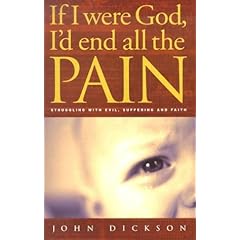
Book review: If I Were God, I'd End all the Pain

Why would a loving God allow so much suffering? All of us have wrestled with this question at some point. Almost every day as a pastor, I encounter people who are dealing with serious trials - people who may be asking this very question.

In the short book, If I Were God, I'd End All the Pain, John Dickson is not afraid to ask the question "Why?" In fact, he believes it's a healthy question that God Himself invites. The author shows that while there is still much mystery woven into our suffering, we can also be confident that Christianity provides the very best explanation for evil and suffering.

After showing why suffering does not disprove God philosophically (ch. 1), the author explains how four alternative faiths attempt to explain suffering.

  • Hinduism views suffering as karma, i.e. bringing balance for past wrongs.
  • Buddhism, which actually developed from Buddha's quest to explain suffering, believes all suffering is just an illusion. It stems from a desire or affection for things of the world (e.g. comfort, health, money, love, etc.). If we can simply strip away these desires and enter a state of nirvana (non-existence), then suffering will cease.
  • Islam believes all things are pre-determined by God, and that suffering is a direct result of Allah, the great "Unmoved Mover."
  • Atheism endures suffering as the natural, unhappy by-product of our random, godless universe.
In contrast to these four views, the Bible has a satisfactory explanation for suffering. Human violence and injustice, which causes so much of the suffering in this world, is really a perversion of the independence God originally gave the human spirit. People now live as "a law unto themselves, without reference to the Creator," and we are reaping what we sow. But what about the profound suffering caused by natural disasters, disease, death, starvation, etc.? These are a result of God's curse upon the world for our sin (Gen. 3:17-19). "The earth bears the scars, as it were, of the traumatic rift that has occurred between us and God; it contains an ever-present reminder that the Creator is displeased with our defiance of him."

The author does not merely explain suffering, but provides three comforting truths that give hope and peace even in times of suffering:
  • God will eventually judge and repay all the injustice in the world.
  • God will eventually restore and re-create His world in perfection.
  • By sending His Son to the cross, God Himself has suffered to the greatest degree, and through His suffering provides a substitute for us, so that we do not have to spend eternity apart from Him.
If I Were God, I'd End All the Pain is a brief but helpful Christian apologetic on suffering. While the Bible does not claim to give us all the answers, it gives us enough to keep clinging to God and persevering through life's darkest moments.

Wednesday, December 17, 2008

The blessings of nursing home ministry

Steve Burchett is a friend I met at the Founders Conference in Oklahoma in 2007. Then I amazingly ran into him again at Together for the Gospel in Kentucky in 2008. He has his own blog and is part of a great ministry called "Christian Communicators Worldwide," which is led by Jim Eliff.

Steve recently wrote an article on "Ten Reasons Why Nursing Homes are Great Places to Minister." Ministering in nursing homes can be difficult work, but it's a huge encouragement to ailing believers as well as an important final witness to the unsaved. It's easy for churches to overlook the homebound and infirm, yet Matthew 25:40 reminds us that when we serve even the least of Christ's brothers or sisters, we are serving Him.

Here's the list Steve came up with:

1. Nursing homes provide an avenue to obey God, Who tells us to serve the downcast and rejected.

2. Nursing homes offer numerous opportunities for evangelism.

3. Nursing home residents will increase your trust in a sovereign God.

4. Nursing homes make available a place of real and life-impacting ministry for young men contemplating or heading into the ministry.

5. Nursing homes present a way to teach children to love their neighbor.

6. Nursing homes remind us that sickness and death are coming.

7. Nursing homes put you in the presence of older saints who are persevering in the Lord.

8. Nursing homes put you in the presence of people who have hardened their hearts, rejected Christ, and may never again have a coherent thought.

9. Nursing homes open doors to new relationships with those related to or associated with the residents.

10. Nursing homes provide a ministry environment where what really matters takes priority.
When's the last time you visited someone in the hospital or nursing home? I admit, the sights, sounds, and smells are not always pleasant, but it's a great opportunity to be a "Good Samaritan" and show the love of Christ to those who are suffering.

A nursing home ministry is something that a church can offically sponsor, or something that individual families can do by themselves on a weekly, monthly, or occasional basis. One thing's for sure - nursing home residents always love visitors!

Thursday, September 11, 2008

Where was God on September 11?

Here on the west coast, many of us woke up seven years ago with the news that our country was under attack. I remember hearing a knock at the door, jumping out of bed, and being told by our neighbors that two jets had just crashed into the World Trade Center towers. We immediately turned on the radio (didn't have cable TV) to hear the description of the first tower collapsing "like a melting candle."

Later that morning at work, I stood in shock as I watched the replay again and again of United Flight 175 crashing into the south tower. It's still sends shivers up my spine: Four hijackings. Thousands killed. All flights cancelled. The dawning of a new war.

Where was God on September 11? Did He fall asleep or "step away from His desk" for a few minutes? Was He surprised by what happened? Did He try to prevent it and fail?

While September 11, 2001 was one of the darker moments in history, it doesn't disprove the existence of a sovereign God. God was firmly seated upon His throne when those terrorists first heard the concept of jihad as little boys. He watched them as they obtained their visas to enter the United States. He was sovereign as they attended flight school, then boarded their flights, then hijacked the planes, and finally steered them into the trade center and the Pentagon. He sees them even now as a holy God who executes His eternal justice (Rom. 12:19).

At any stage, God could have instantly put a stop to this horrible plot, if He had chosen to do so. "The LORD has established His throne in the heavens, and His sovereignty rules over all" (Ps. 103:19). But for reasons known only to Him, God permitted this evil scheme to be carried out.

The fact is, what happened on September 11 is just another example of what God observed several thousand years ago: "Then the LORD saw that the wickedness of man was great on the earth, and that every intent of the thoughts of his heart was only evil continually" (Gen. 6:5).

The terrorist attack seven years ago was a tragic example of human depravity, but it reveals a condition all of us share. It may have been more severe in degree, but it was identical in kind. You see, all of us sin and fall short of God's glory (Rom. 3:23). All of us have rebelled against God. Yet thankfully, God lovingly sent His Son Jesus to rescue us from this condition by paying for that sin once and for all upon the cross. This day and every day, that is very good news to remember.

Friday, August 22, 2008

Remember the prisoners

"Remember the prisoners, as though in prison with them, and those who are ill-treated, since you yourselves also are in the body" (Hebrews 13:3)

One brother in Christ we can remember in prayer is Pastor "Bike" Mingxuan. Pastor "Bike," known for traveling thousands of miles across China on a bicycle to evangelize, was arrested by Chinese police just two days before the Olympics began. He was the inspiration behind a unique wrist band project which encouraged people to pray for China, and has resulted in more than 800,000 bands to be circulated. To learn more about the Olympic Prayer Band, click here.

According to Voice of the Martyrs, Pastor Bike and other Chinese evangelists had been repeatedly harassed by Chinese officials leading up to his arrest. Please pray for the release of Pastor Bike and his wife. And in this Olympic year, please remember the prisoners.

Wednesday, August 13, 2008

Persecution of Christ and the church

On Sunday evening, August 3, I had the privilege of preaching at our former church, Placerita Baptist Church in Newhall, California. The topic for the night was "The Persecuted Work of Christ: The Painful Path to Glory." We looked together at Jesus' discourse in John 15 and noticed four facts about persecution:

1. The Promise of Persecution (Jn. 15:18-21)

2. The Pinnacle of Persecution (Jn. 15:18-21)

3. The Purpose of Persecution (Jn. 15:22-25)

4. The Paraclete of Persecution (Jn. 15:26-27)

Studying and preaching this passage really opened my eyes to the importance of Christ's persecution, the dark reality of persecution over twenty centuries of Christianity, and the tremendous value of the Holy Spirit in times of affliction.

You can download or listen to the sermon here.

Thursday, July 31, 2008

The poison of the therapeutic gospel

While scanning through Paul Marshall's book Their Blood Cries Out, I came across this excellent quote. It shows the poisonous nature of the therapeutic gospel and prosperity gospel in times of suffering. Marshall here sounds very similar to David Wells, and helps explain why so many American Christians are apathetic to global persecution today.

Clearly, a positive outlook can have value in dealing with most of our ordinary day-to-day frustrations. But if God is always supposed to provide relief, then suffering Christians seem to make God appear untrustworthy and the product unreliable. Why hasn't Christianity "worked" for the Sudanese the way it does in America? How can the prayers of suffering Christians in Vietnam remain unanswered?

Historically, the heart of the evangelical gospel has been "Christ died for your sins," not the modern preoccupation "Christ died for your problems." If religious teaching becomes a promise of psychological benefits, then a seemingly logical conclusion is that suffering stems from a lack of faith...

But what does this mean for those who struggle against adversity, persecution, and poverty? If obedience is the key to the future, then they must somehow have failed, somehow have fallen short of God's best, somehow been disobedient. What does it say of the apostle Paul, writing letters from a prison cell, not to mention Jesus, who was markedly "unsuccessful." He found himself betrayed, abandoned, and hung on a cross.

These are not the only tendencies in evangelicalism. But they are the dominant ones. They are the themes that dominate the best-seller lists, the magazines, the TV shows, and all-too-many of the churches. The result is a faith that has its eyes turned resolutely inward.

Self-absorption is clearly not the only reason western evangelicals remain unconcerned about their persecuted counterparts across the sea. But it certainly contributes to the apathy. (pp. 155-56)

Wednesday, July 30, 2008

Update on Tom Ascol

Donna Ascol has finally written an update on her husband Tom, who was struck by lighting two weeks ago. You can read her message here. It sounds like Tom is making a slow and difficult - but steady - recovery. Please continue to keep him in your prayers.

I was convicted over my own lack of sensitivity toward the elderly and infirm as I read this paragraph:

We understand more about the mysteries of the human body and how many people suffer from real symptoms that cannot be viewed by casual observers. Even as Tom struggled through the airport, I wondered how many travelers were aware of his struggle. I doubt that those who were frustrated by his slow gait and halting steps stopped to consider what might be going on inside of him. I pray that God would help me to be more compassionate to those who struggle internally.

Wednesday, January 16, 2008

When experience and theology collide

In the book In God’s Waiting Room, Dr. Lehman Strauss recalls one of the hardest moments in his life:

It was Wednesday, April 14, 1982. Eighteen days had passed since [my wife] Elsie's stroke. The neurologist in charge requested that I meet with him. I waited expectantly in the corridor outside Elsie's room. When the doctor appeared his remarks were brief and pointed. "We are making arrangements to move your wife to a rehabilitation center in San Diego." "What led you to this decision?" I asked. He hesitated. I detected a bit of concern in his delayed reply. I was right. His words came slowly. "There is nothing more that we can do medically for Mrs. Strauss." He placed his hand on my shoulder and patted it gently. "I'm sorry," he said, and he walked away.


For a few seconds I stood motionless, my mind almost blank. Then I walked slowly into the room, kissed Elsie, and sat in the chair beside the bed. She spoke first. "What did the doctor tell you?" "He said that you will be transferred to a rehabilitation center in San Diego." I took her hand in mine. Then I assured her that there was nothing to fear because God was in control. But did I really believe that God was in control?


…We Christians affirm our belief in the sovereignty of God, but our faith is challenged in times of natural upheaval, national disaster, or personal affliction. Pain and poverty, disease and death, sorrow and suffering all tend to cause us to think seriously about God as creator and controller of the world of which we are a part. It is not always easy to believe that God is in control. On that Wednesday in April 1982, my faith was being tested. At that particular moment my mind was not capable of rationalizing the majesty of God's sovereignty. When I was told the seriousness of Elsie's condition, I realized that some cherished plans would have to be canceled. Quite frankly, I could not understand God's reason for this turn of events. But I knew that the Bible contains all we poor mortals need to know. Our Lord said, "It is written, Man shall not live by bread alone, but by every word that proceedeth out of the mouth of God" (Matthew 4:4).

Perhaps some of you have received news as earth-shattering that. Others have not. But we can all be certain of this: the longer God leaves us in this sin-cursed world, the more we can expect “natural upheaval, national disaster, and personal affliction,” and the more our faith will be challenged. Our increasing encounters with suffering will test our level of trust in God. And in moments like these, when experience and theology collide, we desperately need the message of Habakkuk.

The prophet Habakkuk wrote at a very dark time in Israel’s history. The Northern Kingdom (Israel) had already been destroyed and scattered by the Assyrian Empire. Now, the Southern Kingdom (Judah) was bracing for an immanent attack by the Chaldeans (or Babylonians), God’s new instrument of choice to discipline His people. At that moment, Habakkuk’s experience and theology collided. His “experience” told him that the world was falling apart, that God had forsaken His covenant people, and that God was standing silent while the wicked “swallowed up” the righteous (1:13). Yet Habakkuk’s “theology” told Him that God was sovereign, holy, faithful, and just in all His dealings. How could these facts be reconciled?

The key verse in the Book of Habakkuk, where God finally unravels this mystery, is Habakkuk 2:4. “Behold, as for the proud one, his soul is not right within him; but the righteous will live by his faith.” Note the contrast between two kinds of people:

  • The proud. God says that the “proud” (puffed up, inflated) person has a soul that is defective. As a result, the proud will eventually be judged and condemned. The God of vengeance and Judge of the earth will “render recompense to the proud” (Psalm 94:2). In the immediate context, the “proud” describes the Chaldeans, but it extends to all people who are arrogant and self-reliant rather than humble and dependent upon God.
  • The righteous. By contrast, the “righteous” (the morally good, just, fair) will have a “faith” or "steadfast trust" in the Word of God that will cause him to persevere through a trial and patiently wait for God to act. This condition of “righteousness,” is not something we can earn because of any inherent moral goodness. Rather, it is a legal standing before God that occurs when we place our faith in Him. Speaking of Abram, Genesis 15:6 says, “Then he believed in the LORD; and He [God] reckoned it to him as righteousness.” Notice that it is faith alone (not works) that leads God to declare Abram “justified.”

Habakkuk 2:4 is one of the most important verses in the Bible because it summarizes two central truths of Christianity: we are justified by faith in Jesus Christ (Genesis 15:6; Romans 1:17, chs. 1-5), and we persevere by faith in Jesus Christ (Romans 6-8; Hebrews 10:36-39). New Testament scholar S. Lewis Johnson said, “ ‘The just shall live by faith’ – it is, without question, near the soul of Pauline theology…Habakkuk’s great text, with his son Paul’s comments and additions, became the banner of the Protestant Reformation in the hands of Habakkuk’s grandson, Martin Luther.” Dr. John Feinberg described this verse as “The key to the whole Book of Habakkuk…the central theme of all the Scriptures.”

Do you have a faith that endures under trial? Or at the first sign of trouble, do you worry, complain, and grow angry? By the grace of God, when our experience and theology collide, let’s live with a steadfast trust in God and cling to the precious promises of His Word.