Showing posts with label history. Show all posts

Thursday, April 2, 2009

400 years of Baptist faith

Last Sunday, our church hosted Dr. Tony Chute, a history professor from Cal Baptist University, to celebrate 400 years of Baptist faith. Did you know the Baptist church turned 400 this year? It was started in 1609 by John Smyth in Holland. Three years later, the first Baptist church in England was planted by Thomas Helwys in 1612. The Southern Baptist Convention, however, did not arrive until two centuries later, in 1845.

David Dockery, in his book Southern Baptist Consensus and Renewal, explains the relevance of Baptist history for today, particularly for Southern Baptists:

[W]e as Southern Baptists in the early years of the twenty-first century are infected with historical amnesia - we do not know our history, we do not know our theological identity, we basically only understand the programmatic expression of what it means to be a Baptist as we related from local church to local church...Today Southern Baptists need to begin to build a new theologically and historically informed consensus that will help us understand our past, our identity, and our beliefs - so that we can move forward to carry the Gospel around the world and "disciplize" the nations in the twenty-first century.
On Sunday, our church took a tiny step to shake off the historical amnesia and improve our knowledge of church history. Through Tony's message, we learned that Baptists have accomplished four main things in the last 400 years. Basically, each century brought one major contribution:
  • In the 1600's, Baptists defended regenerate church membership.
  • In the 1700's, Baptists stressed the importance of religious liberty
  • In the 1800's, Baptists mobilized for global missions
  • In the 1900's, Baptists battled over the inerrancy of the Bible in all areas
I wonder, what will be our greatest contribution in the 21st century? May this be the century we grow in our unity, mature in our doctrine, and increase in our efforts to evangelize every nation, tribe, tongue, and people.

Wednesday, December 24, 2008

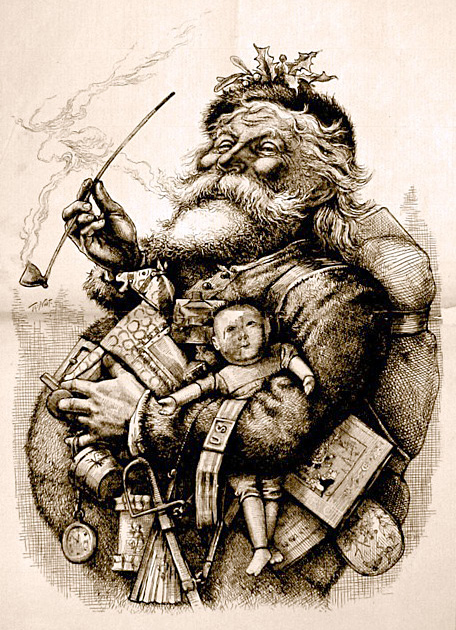
The real Santa Claus

Last week at the dinner table, our 3-year old son Dylan declared, "Santa Claus is BAD!! Santa Claus is BAD!!"

We weren't sure how he arrived at this conclusion, since we'd never referred to Santa Claus as "bad" before, so we probed a little deeper. Maybe, we thought, someone at church had told him this? As time went on, we remembered that Dylan had just watched "How the Grinch Stole Christmas" a couple days earlier, and apparently, he still thought the Grinch was Santa Claus and that he was a bad guy!

As we thought more about it, we realized Dylan had never really heard or seen the classic story of Santa Claus as a jolly old elf who lives on the North Pole and delivers presents on Christmas Eve to boys and girls around the world. So, last week, we watched the 1960s animation "Rudolph the Red-Nosed Reindeer" as a family. (We've reminded Dylan several times that Santa is just a "fun story" while Jesus is real.)

Of course, neither the Grinch nor the elf in the red suit tell us the real story of Santa Claus...

Santa Claus's roots can be traced back to St. Nicholas of Bari. The son of wealthy parents, Nicholas was born in the fourth century in the town of Patara, Lycia (now part of Turkey). Legend records that when his parents died, the young man took all the family's money and distributed it to the needy in his hometown. He then accepted the call to full-time Christian service, becoming a monk when he was only seventeen, and shortly thereafter, a priest. ... Nicholas must have been a remarkable man, wise beyond his years and exhibiting a maturity that few gain until they are well past forty. (Ace Collins, Stories Behind the Great Traditions of Christmas, 159-60)
Gene Edward Veith wrote an article in World Magazine a few years ago that reveals even more about this interesting character:
[Nicholas] was also a delegate to the Council of Nicea in a.d. 325, which battled the heretics who denied the deity of Christ. He was thus one of the authors of the Nicene Creed, which affirms that Jesus Christ is both true God and true man. And unlike his later manifestation, Nicholas was particularly zealous in standing up for Christ.

During the Council of Nicea, jolly old St. Nicholas got so fed up with Arius, who taught that Jesus was just a man, that he walked up and slapped him! That unbishoplike behavior got him in trouble. The council almost stripped him of his office, but Nicholas said he was sorry, so he was forgiven.
Wow. I'm starting to like the real Santa Claus more and more.